


Crab Life: RPG Survival
Supercent, Inc.
I approached Crab Life: RPG Survival expecting a small arcade game built around a simple sea-creature idea, and that is exactly where its appeal begins. I guide a crab through an aquarium-like world, catch fish, and explore a simulation that feels more relaxed than a conventional action game. It is easy to understand within a short session, but the underwater setting gives the basic loop more personality than a standard score-chasing arcade title.
My experience with it is best described as casual rather than demanding. The game suits the moments when I want something I can pick up without studying a complicated control scheme or committing to a long campaign. At the same time, the role-playing and survival framing suggests a little more involvement than a single-screen arcade distraction. That combination makes it interesting for players who enjoy gradual interaction with a themed world, while people looking for deep strategy or a highly competitive challenge may find it too light.
How Crab Life feels in everyday play
A quick start with a deliberately simple rhythm
The central idea is immediately readable: the crab moves around its aquatic environment, catches fish, and continues exploring. I do not need a long explanation to understand what I am supposed to do. That clarity matters on a phone, especially when I am playing during a short break, waiting for transport, or winding down before bed.
The arcade foundation keeps the opening experience approachable. Instead of presenting a dense menu of systems before I can enjoy the game, it puts the creature and its surroundings at the center. For a younger player, the Everyone age rating also makes the concept feel broadly accessible. For an adult, the attraction is different: it is a low-pressure way to spend a few minutes without the mental load associated with a larger role-playing game.
I would not describe the pace as relentlessly fast. The appeal comes from watching the crab operate in its environment and deciding how to approach the next bit of activity. That slower rhythm can be a strength when I want a calming game, but it can feel less exciting if I expect constant action, rapid reactions, or a highly dramatic survival experience.
Related News

Threads in Real Life: Who Should Join, Lurk, or Leave

How SHEIN Turned Shopping Into an Endless Content Feed

How to Make Fortnite Feel Smarter on Mobile

Should You Switch to Microsoft Outlook on Mobile?

Why Gallery Keeps Pulling Users Back

X Review: Why Its Network Still Matters
What speed means in this particular game
When I think about speed here, I separate the game’s response from the game’s overall tempo. A simple arcade control style should feel easy to follow, but the broader experience is not built solely around frantic movement. The aquarium-like setting encourages me to observe what is happening and make small decisions rather than treating every moment as a reflex test.
That makes it a useful choice for casual sessions. I can play while taking a short mental break and stop without feeling that I have abandoned a complicated sequence. The trade-off is that players who prefer the immediate intensity of a traditional arcade challenge may want something more energetic. Crab Life: RPG Survival is more comfortable when I accept its exploratory pace instead of judging it against a fast score-attack game.
One practical tip is to give the opening sessions enough time to reveal the rhythm before deciding whether it is for you. If I rush through the first moments expecting a dramatic challenge, the game can seem too modest. If I treat it as a small aquarium adventure with arcade interaction, its design makes more sense.
Gallery
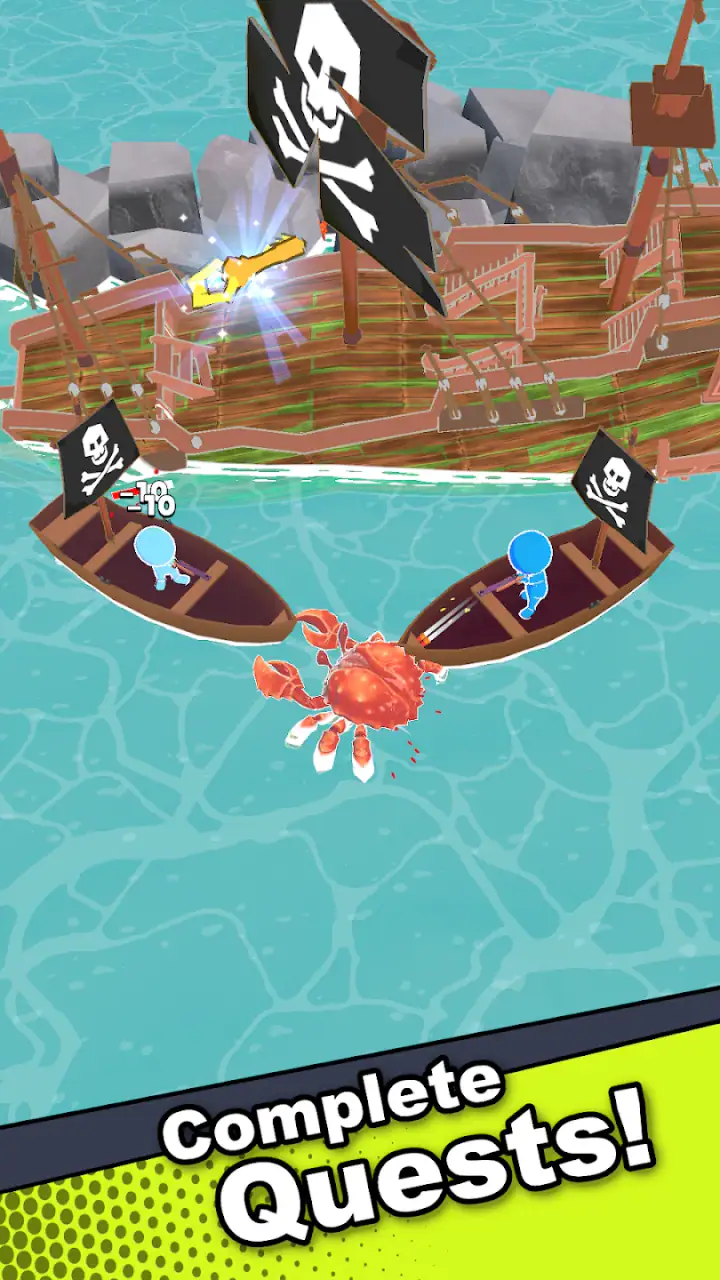
Where longer sessions can feel heavier
The most demanding moments are likely to come from extended play rather than from the basic act of catching fish. Repeated movement, exploration, and interaction can make a simple loop feel more involved over time, particularly if I am trying to make steady progress instead of merely checking in for a few minutes.
This is where the role-playing and survival framing affects my expectations. I want the actions to feel connected to a larger purpose, not just to isolated taps. When the game gives me that sense of ongoing progress, the environment becomes more engaging. When I am only repeating the same activity without a clear personal goal, the arcade simplicity becomes more noticeable.
My advice is to use short objectives for each session. I might decide to explore a particular area, focus on catching fish, or simply spend a few minutes learning the movement. That approach reduces the feeling of repetition and makes the game easier to fit into everyday use. It also prevents me from expecting a full-length role-playing adventure from a title whose strongest quality is its compact, accessible loop.
Stability and the practical play experience
For a mobile game like this, reliability is not only about whether it opens. It is also about whether the experience feels dependable when I return after a break, play briefly, or switch between lighter and longer sessions. The current version is 10.2.0, which tells me that the game has gone through multiple iterations rather than remaining at its earliest release state. It first appeared on July 15, 2024, so I see it as a relatively recent mobile title rather than an established classic.
I still prefer to judge stability through ordinary habits. I would begin with a short session, check that progress behaves as expected, and then gradually play for longer. That is sensible for any game with an exploration loop, because a quick launch test does not reveal how comfortable it is during sustained use. I also avoid treating an arcade game as a place to multitask constantly; interruptions can make any touch-based experience feel less smooth, even when the game itself is behaving normally.
The public response is mixed, with an average rating of 3.0 from around 1.4 thousand ratings and 151 written reviews. I read that as a reason to keep expectations measured. It does not make the game unplayable, but it suggests that the straightforward concept will not satisfy everyone equally. Some players will enjoy the novelty of controlling a crab in an aquarium-like world, while others may want more depth or a more polished-feeling progression loop.
How demanding it is on a phone
The game supports devices running Android 6.0 or later. That compatibility range is useful for people who do not own a recent phone, although compatibility alone does not tell me how every device will handle longer sessions. Hardware, background activity, available storage, and battery condition can all affect the experience.
My practical approach would be to close unnecessary apps before playing on an older device and avoid judging performance while the phone is already under heavy load. A shorter session is also kinder to a modest handset than leaving any game running for a long period. If the device becomes warm or the battery drops quickly, I would treat that as a reason to shorten playtime rather than assuming the game is meant to be played continuously.
This is especially relevant because the game’s appeal is easy to fit into small pockets of time. I do not need to plan a long sitting to enjoy the crab’s environment. On a newer phone, I would expect the most comfortable experience during exploration and repeated interaction, while an older phone may be better suited to brief visits. That is not a criticism unique to this title; it is simply the more sensible way to use a mobile arcade game on varied hardware.
Who will enjoy the aquarium setting
The strongest audience is made up of players who like unusual themes and uncomplicated interaction. A crab as the main character gives the game a playful identity, and the aquarium-like world makes the setting more memorable than an anonymous arena. Children and families may appreciate the approachable presentation, while adults may enjoy it as a gentle alternative to more aggressive survival games.
It also works for people who prefer games that explain themselves through action. I can understand the basic goal without learning a large collection of commands. That makes it suitable for someone who is new to mobile games, provided they are comfortable with a loop focused on exploration and catching fish rather than a story-heavy campaign.
I would be more cautious about recommending it to players who want deep character builds, complex resource planning, competitive rankings, or a large narrative. The label “RPG Survival” may raise expectations of extensive systems, while the actual attraction is the accessible arcade simulation. If those deeper elements are the main reason someone plays, a more established role-playing or survival game would probably be a better match.
How it compares with familiar arcade alternatives
Compared with a conventional arcade game built around rapid scores, this one offers a more relaxed sense of place. I am not only trying to react quickly; I am spending time with a crab in an aquatic environment. That gives the game a stronger theme and makes it feel less disposable than a bare score-chasing loop.
Compared with a full survival game, however, it is easier to approach and likely less demanding in terms of planning. I would choose it when I want the flavor of survival and exploration without committing to a complex system of crafting, combat, or long-term management. I would choose a larger survival game when I want a world that constantly pressures me to optimize resources and prepare for danger.
It also differs from idle aquarium apps. Those usually emphasize watching a collection grow with minimal direct involvement, whereas this game puts the crab’s activity at the center. I have more reason to pay attention because catching fish and exploring are active parts of the experience. On the other hand, someone seeking a purely passive aquarium may find even this light arcade interaction more involved than necessary.
Free access and the cost of continuing
The game is free to download, which makes trying the core idea straightforward. That is important here because the concept is unusual enough that I would want to experience the movement and aquarium setting personally before deciding whether it fits my taste.
There are in-app purchases ranging from $0.99 to $99.99 per item. That wide range changes how I would approach the game. I would begin without spending anything, learn whether the basic loop holds my attention, and only consider a purchase after I understand what it changes for my play. The free entry is a benefit, but the presence of optional purchases means I would keep a close eye on any spending prompts, especially if a child is using the device.
For me, the best way to enjoy a free arcade game with purchases is to treat buying as optional rather than as part of the normal control scheme. If progress feels comfortable without paying, the game can remain a casual pastime. If I start feeling pushed toward spending simply to maintain interest, that is a clear sign to stop and reconsider whether the experience is worth continuing.
Small habits that make the game easier to judge
I found that the game is easier to assess when I separate novelty from longevity. The crab and aquarium setting are immediately distinctive, but the more important question is whether catching fish and exploring remain enjoyable after the first impression fades. I would test that with several short sessions instead of one unusually long sitting.
Another useful habit is to play with a specific intention. A session focused on exploration feels different from one focused on collecting fish, and both reveal more than tapping through without paying attention. This also helps identify whether I enjoy the game’s decisions or merely its visual premise.
I would also avoid comparing it only with premium, content-heavy games. Its free entry and simple arcade structure place it in a different space. The fair comparison is with other quick mobile diversions: does it give me a distinctive setting, understandable interaction, and enough variety to justify returning? For me, the answer is positive when I want something gentle and themed, but less convincing when I am searching for deep progression.
My performance verdict
Crab Life: RPG Survival is at its best as a lightweight arcade simulation with a memorable central character. It gives me an easy way to spend a few minutes catching fish and exploring, and the aquarium-like setting provides more identity than many interchangeable mobile games. The broad Everyone rating and support for Android 6.0 or later also make it approachable for a wide range of players and devices.
My expectations would remain moderate because the 3.0 average rating points to an uneven reception. I would not install it expecting a technically demanding survival epic or a deep role-playing system. I would install it because I like the idea of a crab-led aquatic world and want a simple game that can fill short breaks without requiring a large time commitment.
Supercent, Inc. has made a concept that is easy to understand and easy to try, but its long-term value depends on how much I enjoy the repeated loop. The game is a good fit for casual players, families, and anyone curious about a playful aquarium adventure. It is not the right choice for someone who needs intense action, elaborate progression, or a purchase-free experience with no temptation to spend.
My recommendation is to start with brief, free sessions on the device you plan to use. Pay attention to how the game feels after the novelty of the crab wears off, and decide based on that repeated experience rather than the premise alone. If you want a calm, characterful arcade game for short mobile breaks, this is worth trying; if you want a deep survival RPG, choose a more substantial alternative.
FAQs for Crab Life: RPG Survival
What is Crab Life: RPG Survival about?
Crab Life: RPG Survival is an adventure and survival game that combines role-playing elements with exploration, resource gathering, combat, and character progression. You take control of a crab trying to survive in a dangerous environment, improve its abilities, collect useful materials, and overcome enemies and environmental challenges. The experience is designed for players who enjoy gradual progression, discovery, and lighthearted survival gameplay.
Is Crab Life: RPG Survival free to download and play?
The game is generally presented as a free-to-download mobile title, although availability and pricing can vary depending on whether you use Android or iOS and which region your store account is registered in. Like many free mobile games, it may include optional in-app purchases, advertisements, or both. Before installing, check the official store listing for current purchase details, supported devices, and any age or content information.
Does Crab Life: RPG Survival require an internet connection?
Whether you can play Crab Life: RPG Survival fully offline may depend on the version installed and the feature you are using. Core gameplay could be available without a constant connection, but advertisements, updates, cloud saves, events, account functions, or purchases may require internet access. If you plan to play while traveling, launch the game online first and test its main modes before relying on it offline.
Is Crab Life: RPG Survival suitable for children and casual players?
Crab Life: RPG Survival may appeal to casual players because its colorful setting and crab-themed concept make the experience approachable, while the RPG and survival systems provide goals beyond simple exploration. However, parents should review the official age rating, advertising policies, in-app purchases, and any online features before allowing younger children to play. Difficulty can also increase as enemies and resource demands become more challenging.
What should I check before downloading Crab Life: RPG Survival?
Before downloading, confirm that your Android or iOS device meets the required operating-system version and has enough free storage for the installation and future updates. It is also worth checking recent user reviews, the developer’s update history, permissions, privacy information, and whether your device supports the current release. If the game includes ads or purchases, review those details in the official store listing to avoid surprises.
Pros
- Relaxed crab-themed survival gameplay with a charming
- unusual setting.
- Progression gives you clear goals as you unlock upgrades and new abilities.
- Short play sessions make it convenient for quick mobile gaming.
- Exploration offers rewards that encourage you to search beyond the main path.
- The lighthearted presentation keeps the experience approachable for younger players.
Cons
- Some upgrades may require considerable grinding before they feel impactful.
- Combat can become repetitive when facing similar enemies for extended periods.
- The small-screen controls may feel imprecise during hectic encounters.
- Limited narrative depth may disappoint players seeking a story-driven RPG.
- Performance and loading times can vary across older mobile devices.


